On Civilizational Cyclicality
Introduction
Recent commentary in policy and journalistic circles, typified by essays such as The New York Times piece titled “America Is Officially an Empire in Decline,” interprets the contemporary geopolitical moment through the lens of strategic errors, imperial overreach, and episodic miscalculation. Within this framing, hypothetical or proximate conflicts, including discursive references to the 2026 war on Iran, are positioned as decisive inflection points that accelerate or reveal systemic deterioration. Such accounts capture visible strain but remain analytically confined to event-centric and state-centric logics. They presuppose that decline is triggered rather than emergent, that empire is an attribute of a nation-state rather than a structural condition of a broader configuration, and that capacity, whether military, economic, or technological, constitutes the primary metric of systemic vitality. When examined through the historical-sociological framework of Ibn Khaldun, integrated with contemporary systems thinking framework, each of these assumptions proves incomplete. They mistake manifestation for causation, scale for structure, and output for coherence.
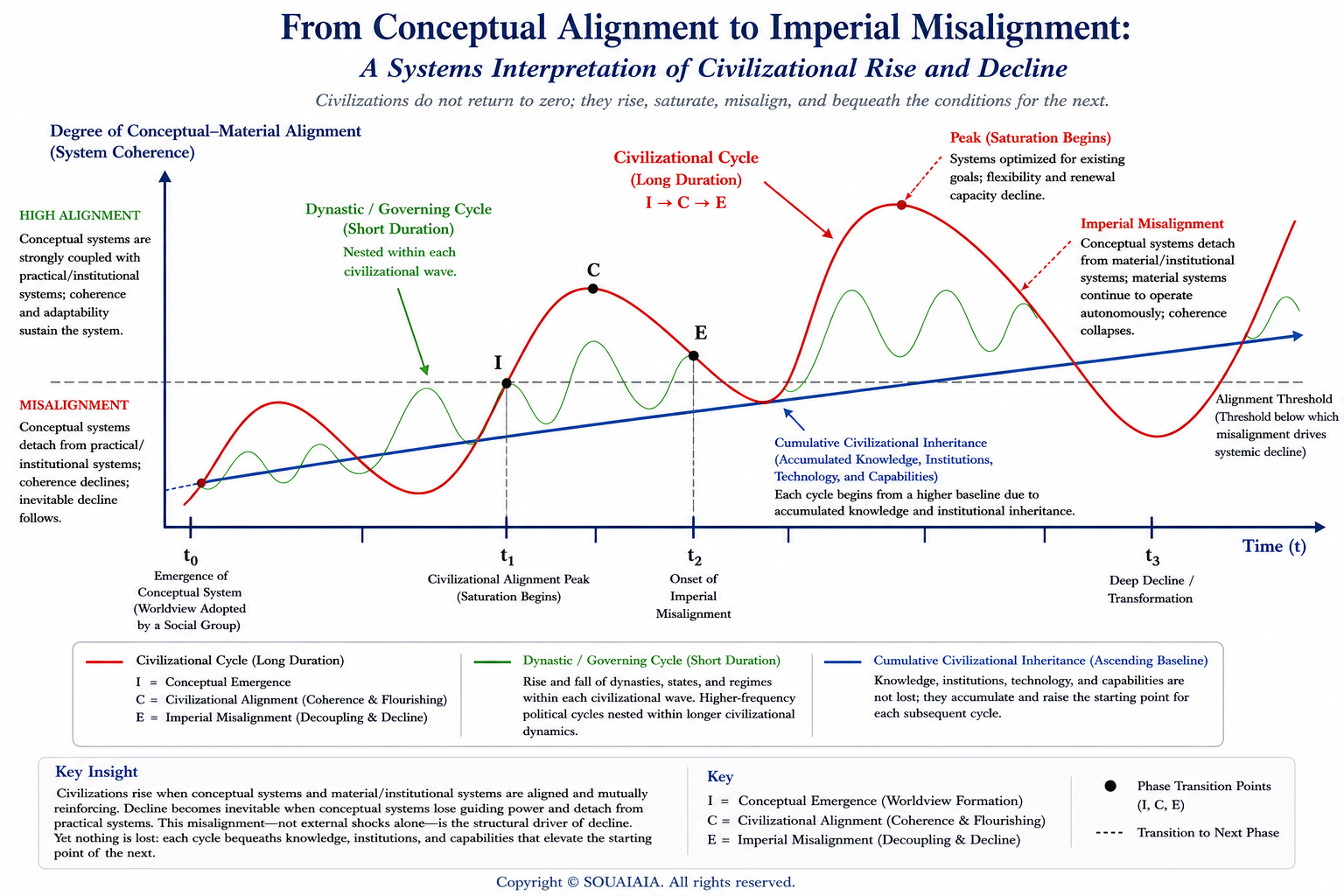
This essay advances three interrelated corrections. First, it displaces the nation-State as the unit of analysis, arguing that what is colloquially termed “American power” is better understood as the latest concentration of power within a civilizational formation that predates the United States and will likely outlast its hegemonic phase. Second, it reconceptualizes empire not as territorial expansion but as a structural misalignment between conceptual systems and praxeological systems, a decoupling that occurs as institutional complexity outpaces social cohesion. Third, it introduces the concept of systemic completion to explain why late-stage configurations appear simultaneously powerful and incoherent: They have achieved maximal functional output, after which internal feedback structures prioritize continuation over adaptation. The visible crises of the present are not the origin of decline but the legible outputs of a configuration that has exhausted its adaptive capacity. Recognizing this shifts the analytical focus from episodic collapse to civilizational transition, from capacity metrics to alignment diagnostics, and from state succession to systemic reconfiguration.
> Read the essay, Systemic Completion, Civilizational Misalignment, and the Illusion of Imperial Crisis


Comments
Post a Comment